Staring at a blank wall and picturing something completely different is easy. Getting from that picture to a finished feature wall is where most homeowners in Singapore start asking questions. How big should the mural be? What kind of printing holds up in our humidity? Who actually installs it, and how much should you set aside?
This guide walks through the practical side of buying a wall mural, from measuring your space correctly to understanding the difference between printing methods and what installation really involves. Whether you’re dressing up a living room, a child’s bedroom, or a café corner, the same basic steps apply, and knowing them upfront saves you from costly resizing or a mismatched finish later.
Getting Your Measurements Right
Before browsing any catalogue of murals or patterns, measure your wall properly. Use a laser measure or tape and record the width and height at several points, since older HDB and condo walls are rarely perfectly straight. Note the position of switches, skirting boards, and any protruding fixtures, as these all affect how the panels are cut and aligned.
A few things to check before ordering:
- Wall height from skirting to ceiling, measured at both ends and the middle
- Total width, accounting for any curves or corners the mural needs to wrap
- Obstructions like light switches, air-con units, or window frames
- Whether the wall surface is smooth, textured, or freshly plastered
Most suppliers ask for these measurements in centimetres and will confirm panel sizing based on your numbers, so double-checking before you submit them is far easier than requesting a reprint.
Understanding Wall Mural Wallpaper Sizes

Wall mural wallpaper typically comes in either fixed panel sizes or custom-printed dimensions tailored to your exact wall. Fixed panels are usually sold in standard widths, printed as a repeating set that you piece together like a large jigsaw, and tend to suit budget-conscious projects with fairly standard wall proportions.
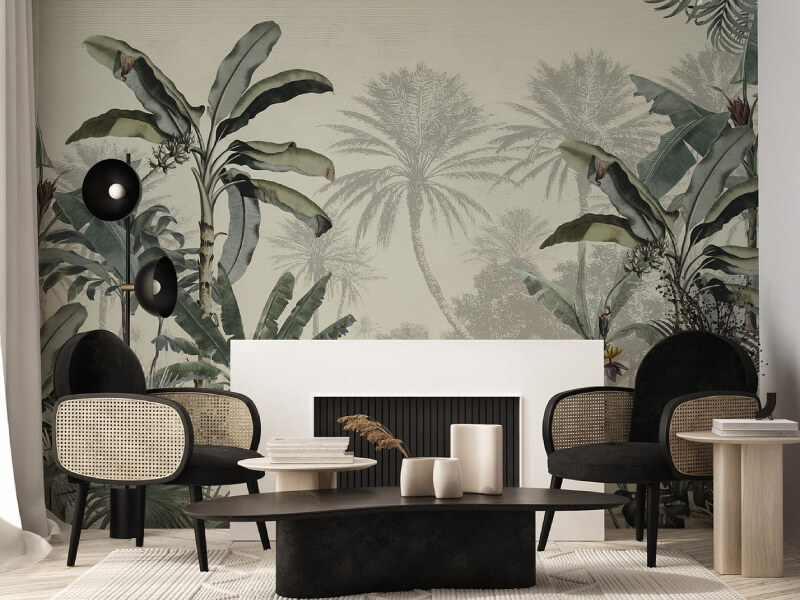
Custom sizing, on the other hand, is printed to match your wall precisely, so there’s no cutting and matching guesswork involved. This route costs more but reduces waste and gives a cleaner, more seamless result, particularly for large feature walls or murals with intricate designs like botanical scenes or skylines where misaligned seams would be obvious.
Printing Methods and What They Mean for Durability
Not all mural printing is created equal, and the method used affects both appearance and lifespan.
- Digital inkjet printing is the most common approach for custom murals, offering sharp detail and accurate colour reproduction at a reasonable cost
- UV-cured printing dries almost instantly and resists fading better, which suits rooms that get direct sunlight
- Textured or embossed finishes add a tactile quality, useful for murals meant to mimic brick, stone, or fabric
In Singapore’s climate, humidity resistance plays a bigger role than most people expect when choosing a finish. Ask your supplier whether the ink and base material are rated for tropical conditions, especially if the mural is going in a bathroom, kitchen, or a room without regular air-conditioning. Cheaper prints can start peeling or discolouring within a year in these environments, while properly rated materials tend to hold their colour and adhesion for considerably longer.
What Installation Actually Involves

Installing a wall mural isn’t quite the same as hanging standard wallpaper, particularly for large or custom panels. Professional installers usually follow a sequence: preparing and smoothing the wall surface, dry-fitting the panels to check alignment, applying adhesive section by section, and carefully smoothing out air bubbles as they go.
Wall preparation is often the step homeowners underestimate. Any bumps, cracks, or old paint flaking on the surface will show through the finished mural, so a proper skim coat or sanding session beforehand makes a noticeable difference to the final look. If your walls were recently painted, check how long the paint needs to cure before wallpaper adhesive can be applied safely.
For anyone considering a DIY approach, smaller single-panel murals in low-traffic spaces are reasonably manageable with patience and a helping hand. Larger multi-panel installs, curved walls, or anything involving intricate pattern matching are usually better left to professionals, since a misaligned seam is difficult to fix once the adhesive sets.
Working Out the Costs

Mural pricing in Singapore generally depends on three things: the size of the wall, the printing method chosen, and whether installation is included. Basic fixed-panel designs on standard paper tend to sit at the lower end, while custom-printed, UV-cured, or textured murals for larger walls push costs upward.
Installation fees are usually charged separately and vary based on wall condition, room accessibility, and panel count. A straightforward single-wall job in a HDB living room costs less than a multi-wall mural wrapping around a curved feature or a commercial space with tricky access. Getting a few quotes with photos and measurements of your wall is the most reliable way to get an accurate figure, since online estimates rarely account for the quirks of your specific space.
A Few Practical Tips Before You Commit
- Request a physical sample swatch if possible, since colours can look different on screen versus in your actual lighting
- Ask about the warranty on both the material and the installation work
- Confirm turnaround time, especially if you’re working around a renovation deadline
- Check whether the supplier offers touch-up services in case of accidental damage later on
A mural is a fairly long-term investment in how a room feels, so taking the extra week to compare samples and installers properly tends to pay off compared with rushing the decision.
Choosing the right wall mural comes down to matching your space, budget, and lifestyle to the right combination of size, print quality, and installation approach. Getting the measurements and material right from the start means fewer surprises and a feature wall that actually lasts. If you’re ready to explore designs suited to Singapore homes, get in touch with Wallhub for a consultation and see how the right mural can transform your space.