Bedrooms get the least design attention of any room in the house, which is odd given they are the first thing you see every morning. Guests never go in, so the walls stay whatever shade the previous owner left behind, and the room ends up feeling like a corridor with a bed in it.
Texture is the quickest way to change that without repainting the whole flat. A tactile finish catches light across the day, softens hard edges and gives a plain room some depth. Choosing texture paint for bedroom walls also sidesteps the pattern commitment that puts some people off wallpaper entirely.
Why Texture Reads Differently In A Bedroom
Bedroom lighting is unlike anywhere else in the home. Morning light comes in low and direct, afternoons are often shuttered against the heat, and evenings run on warm bedside lamps. A flat emulsion looks much the same under all three.
A textured surface changes character with each one, picking up shadow in the morning and settling into something softer at night. That shifting quality is precisely why these finishes suit the room where you spend the most hours, since the wall never quite looks the same twice.
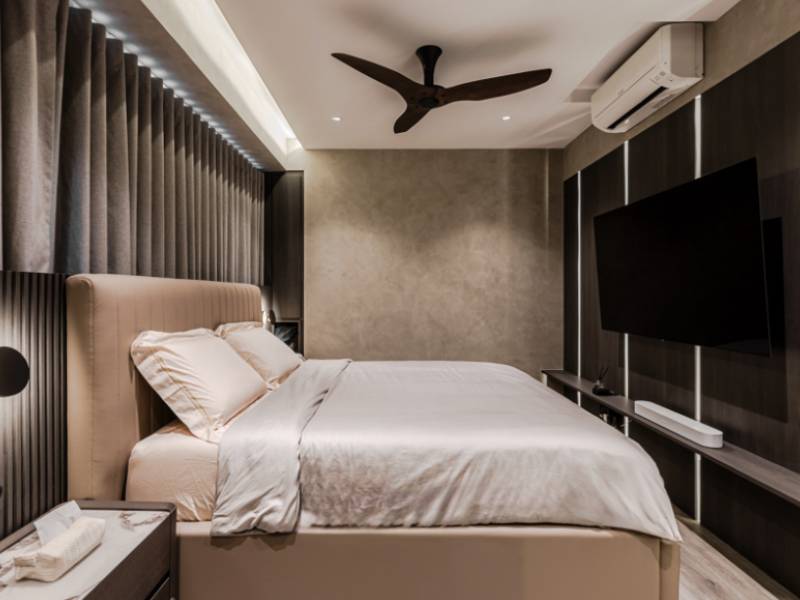
The effect is also gentler than pattern. A feature wall behind the headboard gains presence without demanding attention the way a bold print would, which helps in a room whose main job is to help you switch off.
Finishes That Stay Calm
Not every texture belongs in a bedroom. Heavy stone effects and pronounced trowelled patterns look excellent in a hotel lobby and slightly aggressive behind a pillow. Softer, cloudier applications tend to work better here, where you are looking at the wall from a metre away while half asleep.
Terra texture paint covers this ground across several series, including Organic and Crème for gentle, mineral-looking surfaces, plus Metallic and Geometric options when you want more presence. Over 100 colours run across the Organic, Crème, Éclat, Glamour and Mellow codes, applied as a single tone, a multi-tone blend, or with geometric groove lines for a more architectural effect. Novacolor from Italy sits alongside these for specialised decorative work.
Scale is part of the calculation. A fine, sandy texture reads as almost plain from across the room and only reveals itself up close, which suits a compact bedroom where a heavier finish would feel closed in. Larger, more sculptural textures need distance to be appreciated, so they sit better in a generous master bedroom with space at the foot of the bed.
Sheen is the other lever. A matte surface absorbs light and keeps the room soft, while anything with a subtle sheen picks up the glow from bedside lamps and lifts a darker colour. Bedrooms generally do better at the matte end, with any shine saved for a small detail instead of a whole wall.
Colour Pairings That Work Behind A Bed
Muted and slightly warm tends to beat cool and crisp in a bedroom. Soft clay, oatmeal, warm greige and dusty terracotta all flatter skin tones under lamplight and avoid the faintly clinical feel that pure greys can bring after dark.
Deeper shades are not off limits either. A muted olive or a soft charcoal behind the headboard can make a bedroom feel enclosed and restful, provided the rest of the room stays light. The trick is keeping the ceiling and the opposite walls pale, so the darker surface reads as deliberate depth instead of a shrinking room.
Undertone consistency across the room does most of the heavy lifting. Once you know how a shade behaves in your particular light, everything else gets easier, and the principles set out in limewash colours for Singapore’s natural light apply just as neatly to a textured finish.
Practical Points Before You Commit
A few things are useful to settle in advance:
- Texture holds dust slightly more than flat paint, so a gentle wipe or a soft brush attachment every few months keeps it looking fresh
- Deeper textures are harder to touch up invisibly, which is a real consideration in a rented flat
- Terra products are water-based, low odour and free from formaldehyde and lead, which helps if you will be sleeping in the room soon after application
- The finish is crack-resistant, though walls with existing structural cracks still need those addressed first
- One feature wall plus three plain walls is often more effective, and cheaper, than texturing the entire room
Working With What The Room Already Has
Bedrooms come with fixed elements you cannot change: a built-in wardrobe in a particular laminate, a timber floor, a window with a specific outlook. Texture works best when it responds to those instead of competing with them. A warm oatmeal finish next to light oak joinery feels considered, while a cool grey against the same wood can read as an accident.
Application method changes the result as much as the colour does. Sponge work produces a mottled, cloud-like surface, a soft brush leaves directional movement, and spray application gives the most uniform grain. Seeing samples prepared all three ways is far more useful than choosing from a colour chip, because the same shade can look like two different products depending on how it goes on.
Making A Start
A bedroom refresh does not need to become a full renovation. One wall, the right finish and a colour that suits your light can change how the room feels to wake up in, and most of the work happens within a day or two.
Think about headboard height while you plan, since a good portion of any feature wall sits hidden behind the bed. Carrying the finish higher up the wall, or across the full width including the bedside tables, keeps the effect from looking like a rectangle that stops abruptly.
If you would like to see and touch the finishes before deciding, Wallhub’s gallery has samples applied across a range of techniques, and our team can advise on what suits your lighting and your existing furniture. Come by the showroom or get in touch, and we will help you find something your bedroom actually deserves.